

The market for diesel particulate filters will continue to grow in the coming years. This is due to a high number of vehicles worldwide, stricter emission regulations and the increasing importance of maintenance, cleaning and retrofitting of existing exhaust systems. Market analyses forecast stable growth until 2033 with increasing relevance of the aftermarket segment.
Content
- 1. why the market for diesel particulate filters remains relevant
- 2. global market development: figures, growth and forecasts
- 3. key drivers of the diesel particulate filter market
- 4. the growing importance of maintenance, cleaning and servicing
- 5. why the diesel particulate filter market continues to grow despite electromobility
- 6 Sustainability, retrofitting and future prospects
- Conclusion: A market with long-term relevance
1. why the market for diesel particulate filters remains relevant
The discussion about diesel engines and alternative drive concepts is present in many public debates. However, while electromobility is becoming increasingly important in selected segments, diesel engines remain central to many areas of mobility and industry. Commercial vehicles on trunk roads, construction and agricultural machinery, municipal vehicle fleets and industrial applications will continue to rely on diesel technology in the coming years – and therefore on functioning exhaust gas aftertreatment systems.
A core component of these systems is the diesel particulate filter (DPF): it captures soot and particulate emissions before they are released into the environment, thereby fulfilling legal requirements for limiting emissions. The DPF market is therefore not a relic of earlier decades, but a current and growing segment with clearly measurable trends and developments.
Market research shows that the global diesel particulate filter market has grown significantly in recent years and continues to expand according to all forecasts. Despite the debate about alternative drive systems, the diesel particulate filter market therefore remains a dynamic and relevant field in the long term.
2. global market development: figures, growth and forecasts
2.1 Scope and scaling of the market
The latest market analyses paint a clear picture: the diesel particulate filter market continues to grow – not as a short-term rash, but as a structural trend. At the same time, the reports show that market sizes can differ depending on how they are defined (e.g. by included segments, regions or OEM/aftermarket share). This is precisely why it is worth looking at several sources side by side.
One example is provided by Verified Market Reports, which estimates the market size of the diesel particulate filter (DPF) market at USD 5.2 billion for 2024, with an outlook of USD 8.8 billion by 2033 – at a forecast growth rate (CAGR) of 6.1%.
A second perspective is provided by IMARC Group: The report puts the global market at USD 16.1 billion for 2024 and expects around USD 30.8 billion by 2033, at a CAGR of 6.77% (2025-2033). IMARC cites stricter emissions regulations, the continued use of diesel engines in several sectors, technological advancements in filter technology and increasing environmental awareness as key growth drivers.

The differences in the reported market volumes can be explained primarily by the respective market definition. While some analyses consider the diesel particulate filter as a single component, other studies define the market more broadly and include additional applications, system components and parts of the aftermarket. Despite these differences, all forecasts consistently show stable growth over the entire period under review.
These forecasts are based not only on the number of diesel-powered vehicles, but also on the widespread use of DPF technologies in various fields of application. IMARC explicitly refers to the increasing use of diesel engines in sectors such as automotive, construction and industrial machinery – i.e. precisely where long running times, high loads and strict specifications often come together.
2.2 Regional differences in the growth trend
Although the diesel particulate filter market is growing globally, there are regional differences in development and dynamics.
Europe is still considered a particularly regulated market: the early and gradually tightened emission standards of the Euro norms have driven the widespread introduction of particulate filters here. Regions with strict regulations tend to develop a mature aftermarket and maintenance sector, as a large vehicle population generates regular service and spare parts cycles.
North America is experiencing stable demand for particulate filters and replacement solutions due to EPA regulations and extensive diesel fleets, particularly in the heavy-duty segment. The combination of strict standards and a large inventory of diesel engines is strengthening both the OEM and aftermarket sectors here.
Asia-Pacific is one of the most dynamic markets: In China, India and other emerging markets, both vehicle numbers and regulatory requirements are increasing. This has led to a rapidly growing demand for emission-reducing technologies.
In regions such as the Middle East and Africa, the market is more fragmented, characterized by less regulatory pressure but rising demand in urban areas and an increasing number of imported vehicles.
2.3 Market segments and growth drivers
The diesel particulate filter market is not a homogeneous unit, but is made up of various segments. These include, among others:
- Original Equipment (OE) for new vehicles
- Aftermarket filters for replacement and maintenance
- Cleaning and reprocessing services
- Retrofit solutions for existing vehicle fleets
While the OE segment is strongly influenced by vehicle production and emission standards, the aftermarket and maintenance segments are showing an additional layer of growth. This results from the increasing lifespan of modern vehicle fleets and the need for regular maintenance, including filter cleaning and repairs.
The DPF cleaning and maintenance sector is also growing significantly – this can now also be backed up with concrete market figures. The report “Diesel Particulate Filter (DPF) Cleaner Market Size, Share, and Growth Forecast, 2026-2033” by Persistence Market Research puts the global market for DPF cleaner/DPF cleaning solutions at USD 25.9 billion in 2026 and forecasts growth to USD 43.0 billion by 2033. A compound annual growthrate (CAGR) of 7.5% is given for the period 2026-2033. Among other things, the report cites stricter emission standards, growing diesel fleets and the increasing importance of maintenance to ensure vehicle performance and compliance as drivers.
2.4 Influence of emission standards on market expansion
A key driver of market growth is emissions regulations, which have been tightened over decades. Regulations such as Euro 6 in Europe, as well as EPA and Chinese standards, are forcing manufacturers to integrate diesel particulate filters into new vehicles and continuously improve their efficiency.
This legal framework has three important effects:
- Spread of particulate filters in new vehicles
- Growth of the aftermarket for replacement and maintenance
- Pressure to innovate in filter technology and regeneration systems
This keeps the market not only quantitatively relevant, but also technologically on the move.
3. key drivers of the diesel particulate filter market
The positive development of the diesel particulate filter market cannot be attributed to a single factor. Rather, several structural drivers are working together, reinforcing each other and giving the market long-term stability. Market analyses show that regulatory requirements, technical developments and economic constraints in particular are continuously increasing the demand for functioning particulate filters.

3.1 Statutory emissions targets as a key driver of growth
The most important driver for the diesel particulate filter market is statutory emission standards. In almost all industrialized nations, limit values for particulate emissions have been significantly tightened in recent years. In Europe, the Euro 5 and Euro 6 standards in particular are largely responsible for the fact that diesel particulate filters are now standard.
In view of the forthcoming Euro 7 regulation, it is clear that the requirements will not only remain, but will continue to increase. Unlike previous standards, in future not only laboratory values will be taken into account, but also real emissions over longer periods of time. As a result, there is a greater focus on the long-term functionality of exhaust gas aftertreatment.
Market analyses emphasize that this development structurally secures the DPF market. This is because a particulate filter only fulfills its task reliably if it is technically intact and regularly serviced. Legal requirements are therefore not only effective when purchasing a new vehicle, but throughout its entire life cycle.
Similar developments can also be seen outside Europe. In the USA, EPA regulations ensure high requirements for heavy-duty vehicles, while countries such as China and India have massively tightened their emission standards in a short space of time.
3.2 High number of diesel vehicles worldwide
Another key driver is the enormous global stock of diesel-powered vehicles and machines. While new registrations in the passenger car sector are declining in some countries, diesel engines remain indispensable in many applications.
These include, among others:
- Heavy commercial vehicles in long-distance and distribution transport
- Municipal vehicles such as refuse collection vehicles, buses or winter services
- Construction and agricultural machinery
- Industrial units and stationary diesel systems
Market research institutes point out that these vehicle groups have significantly longer life cycles than classic passenger cars. Service lives of ten, fifteen or even twenty years are no exception. This results in a large population that is permanently dependent on functioning exhaust gas aftertreatment.
3.3 Technological development of filter technology
The technical development of modern particulate filters is also contributing to market growth. New generations of filters are more efficient, filter finer particles and work with more complex regeneration mechanisms. At the same time, they react more sensitively to operating conditions, driving profiles and maintenance intervals.
Modern DPF systems have significantly higher requirements for temperature management, sensor technology and exhaust gas routing. Unfavorable driving cycles – such as frequent short trips or low exhaust gas temperatures – can impair regeneration and lead to deposits in the long term.
This technical complexity means that maintenance, diagnostics and cleaning must no longer be seen as an exception, but as an integral part of vehicle operation. It is precisely this aspect that is strengthening the market for accompanying services relating to diesel particulate filters.
3.4 Economic pressure on operators and fleets
In addition to regulatory and technical factors, economic efficiency also plays a decisive role. In many cases, replacing a diesel particulate filter is associated with considerable costs. Depending on the vehicle type, these can amount to several thousand euros, plus downtime and follow-up costs.
Market studies show that operators are increasingly looking for economical alternatives to control operating costs. This is driving demand for professional cleaning, reconditioning and repair of particulate filters. At the same time, interest in in-house DPF cleaning systems is growing in workshops and among fleet operators.
As a result, the diesel particulate filter market is increasingly developing from a pure product market into a service and life cycle market.
4. the growing importance of maintenance, cleaning and servicing
A key trend that is emphasized in almost all market analyses is the increasing importance of maintenance and servicing measures. Although diesel particulate filters are technically considered durable components, they are not subject to maintenance-free operation.
4.1 Why particulate filters lose performance in the long term
During normal operation, the diesel particulate filter collects soot particles, which are burned off during regeneration. In addition to soot, however, ash residues are also produced from engine oil additives, fuel residues and combustion by-products. This ash cannot be regenerated.

Over time, this leads to:
- Increasing clogging of the filter channels
- increasing exhaust back pressure
- reduced engine power
- higher fuel consumption
This process is unavoidable and occurs regardless of vehicle type or manufacturer. The question is therefore not whether a particulate filter needs to be serviced, but when.
4.2 Effects on vehicle operation and economic efficiency
A dirty or partially blocked particulate filter has a direct effect on operation. Vehicles react with warning messages, emergency running programs or loss of power. This can have considerable economic consequences, especially for commercial vehicles.
In practice, exhaust gas and regeneration issues are among the recurring causes of workshop visits and unscheduled downtimes for many commercial vehicles – especially with demanding driving profiles.
The professional cleaning of a diesel particulate filter makes it possible to largely restore the permeability and make the original function usable again. Market analyses are increasingly identifying this area as an independent growth segment within the exhaust aftertreatment market.
4.3 Growth of the market for DPF cleaning and reconditioning
Several market reports now make a clear distinction between the classic diesel particulate filter market and the market for cleaning, maintenance and associated service solutions. The latter is growing particularly dynamically because it functions independently of new vehicle sales and instead ties in with existing fleets and proven usage models.
According to the report “Diesel Particulate Filter (DPF) Cleaner Market Size, Share, and Growth Forecast, 2026-2033” by Persistence Market Research, the global market for DPF cleaner/DPF cleaning solutions will grow from USD 25.9 billion in 2026 to USD 43.0 billion by 2033 – at a projected compound annual growth rate of 7.5% over the period 2026-2033. According to the analysis, this development is primarily due to stricter emission standards, a growing number of diesel-powered vehicles and an increasing need for permanently functioning exhaust systems.
A separate report on the DPF cleaning machine industry shows additional figures: The market for DPF cleaning machines was estimated at around USD 150 million in 2024 and is expected to grow to around USD 250 million by 2033, with an annual growth rate of around 6.5% during the forecast period. This development is being driven primarily by increasing emissions standards and the growing demand for efficient maintenance solutions in workshops and fleet operations.
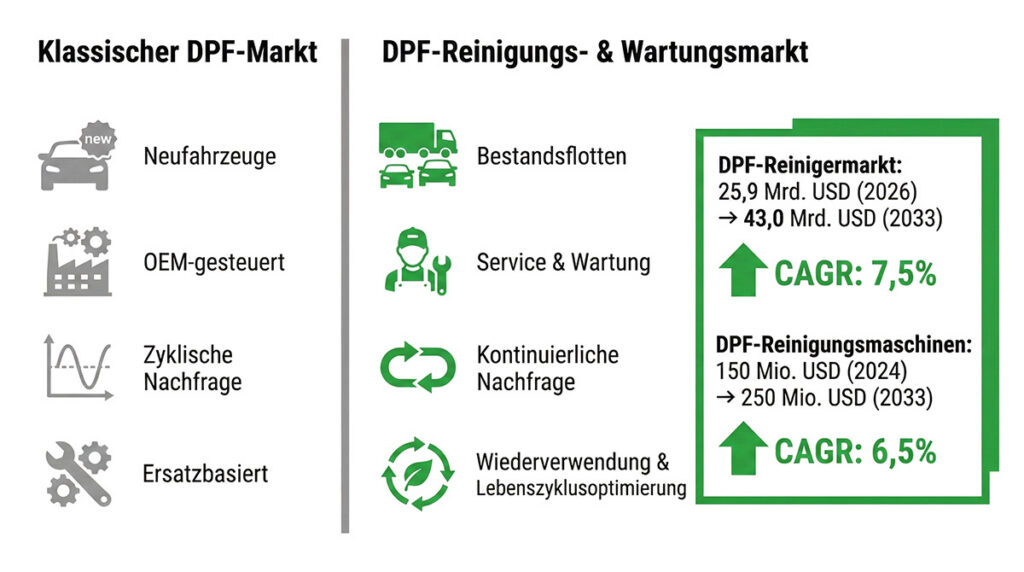
These figures prove that cleaning, maintenance and associated machine solutions are not just a niche market, but a growing market segment with independent growth rates and relevant drivers in terms of volume. Investors, workshops and fleet operators are responding to this with structured maintenance concepts that reduce economic operating costs and ensure the long-term functionality of exhaust systems.
4.4 Cleaning as a sustainable alternative to replacement
In addition to economic arguments, the sustainability aspect is also becoming increasingly important. Replacing a particulate filter not only incurs high costs, but also consumes considerable resources in the production of new filters.
Reconditioning existing filters makes an important contribution to reducing CO₂ emissions and material consumption. In many cases, filters can be reused over long periods of time after professional cleaning.
DPF cleaning thus fits into the overarching concepts of the circular economy – an aspect that is becoming increasingly important both politically and socially.
5. why the diesel particulate filter market continues to grow despite electromobility
The increasing electrification of transportation is often cited as a counter-argument for the long-term importance of diesel drives. However, a closer look reveals a much more nuanced picture. Although the proportion of electric drives is continuously increasing, especially in the passenger car segment, diesel will remain indispensable in many other areas of application in the coming years.
Electrification has so far reached its technical and economic limits, particularly in heavy commercial vehicles, construction and agricultural machinery and special vehicles. These applications require long ranges, constant power output and reliable usability under demanding conditions – requirements that are currently mainly met by modern diesel engines.
Accordingly, the need for efficient exhaust gas aftertreatment remains. The focus is shifting less to the drive itself, but increasingly to its emission behavior in real operation.
In addition, existing vehicle fleets remain in use over the long term. Vehicles are not replaced in the short term, but are used over their entire life cycle. Especially in fleets, in the municipal sector or in industry, renewal takes place gradually over many years. This results in a continuous need for maintenance and servicing, which is largely independent of current new registrations.
Against this background, the diesel particulate filter plays a central role in the transition between current drive technologies and future mobility concepts – as a connecting element between economical operation and reduced-emission use of existing vehicles.
5.1 Existing vehicles as a stable market anchor
The large number of diesel-powered vehicles worldwide is a key driver of their continued market significance. In many regions, these vehicles continue to characterize everyday life – especially where high mileage, robust technology and economic efficiency are required. This stock will not be replaced in the short term, but will remain in use for long periods of time.
Replacement investments are associated with considerable costs, particularly in the commercial vehicle sector. Instead of replacing the entire fleet, many operators therefore opt to optimize existing vehicles. Maintenance, professional cleaning and targeted retrofitting make it possible to maintain technical performance and emissions compliance for years to come.
This approach strengthens the aftermarket in particular and means that the diesel particulate filter market is less dependent on economic fluctuations than other areas of the automotive industry. Demand does not arise from short-term purchasing decisions, but from the ongoing operation of existing vehicles.
5.2 Emission requirements remain open to all technologies
At the same time, a clear regulatory approach is emerging in many countries: The focus is not on the drive type itself, but on the actual emission performance of a vehicle in operation. The decisive factor is which emissions are emitted – not how they are generated.
As long as diesel engines reliably comply with the applicable limits, they remain permissible. This means that the quality of exhaust gas aftertreatment is increasingly coming into focus. Functioning diesel particulate filters are becoming a prerequisite for ensuring that vehicles can be operated in compliance with regulations in the long term.
This open-technology approach shifts the discussion away from the “if” of a drive to the “how clean” of its operation. In practice, this strengthens the importance of reliable, efficient and permanently functioning exhaust gas aftertreatment systems – and thus also the role of the diesel particulate filter within modern vehicle fleets.
6 Sustainability, retrofitting and future prospects
In addition to economic and regulatory factors, sustainability is becoming increasingly important. Companies, local authorities and fleet operators are faced with the task of reducing emissions without rashly replacing existing resources.
In this context, the diesel particulate filter market is increasingly developing into a component of sustainable mobility concepts.
6.1 Retrofitting as a key technology in existing buildings
Retrofitting existing vehicles plays a central role here. Modern exhaust gas aftertreatment systems allow older vehicles to be technically upgraded and adapted to current emission requirements.
Retrofit solutions are an economically viable alternative to buying a new vehicle, particularly in the municipal sector, for special vehicles and in industrial applications.
As a result, the market for exhaust gas aftertreatment is not only growing in the new vehicle segment, but above all in existing vehicles – an area with long-term potential.
6.2 Sustainability through reprocessing
The professional cleaning of diesel particulate filters makes a significant contribution to conserving resources. Instead of energy-intensive new production, existing components can be reused.
Market research analyses are therefore increasingly assigning DPF cleaning to the circular economy. It reduces material consumption, lowers CO₂ emissions and extends the service life of technical systems.
This development is in line with the growing ESG requirements of many companies and public sector clients.
6.3 Technological progress in the service sector
The diesel particulate filter service area is also continuing to develop. Modern cleaning procedures, digital diagnostics and documented maintenance processes increase transparency and planning reliability.
Market studies show that customers increasingly value traceable processes, reproducible results and documented cleaning successes. This strengthens the professional market against improvised or unsuitable processes.
The diesel particulate filter market is therefore not just a product market, but increasingly a quality and process market.

Conclusion: A market with long-term relevance
The evaluation of international market analyses clearly shows that the market for diesel particulate filters is not in decline, but is undergoing structural change.
While the focus used to be on the original equipment of new vehicles, the importance is increasingly shifting to:
- Maintenance and servicing
- Professional cleaning
- Retrofitting existing systems
- Sustainable use of existing resources
Regulatory requirements, economic pressure and ecological demands are acting together as growth drivers.
The diesel particulate filter therefore remains a central component of modern exhaust gas aftertreatment – both today and in the coming years. Companies that take a holistic approach to this development are making an important contribution to reducing emissions, to economic efficiency in vehicle operation and to the sustainable use of technical systems.
About the author
This article has been professionally reviewed by Advanpure, an owner-managed German company with over 15 years of experience in the cleaning of diesel particulate filters, the sale of professional DPF cleaning machines and the retrofitting of modern exhaust aftertreatment systems.
The classification is based on practical experience from workshop, fleet and industrial applications as well as on the evaluation of publicly available industry analyses.
Data basis for this article
- Verified Market Reports
- IMARC Group
- Persistence Market Research
All market data is based on publicly available industry analyses and is used to classify global developments.