

At first glance, P2463 and P2002 appear to be the same DPF fault, but diagnostically they are not the same thing. While P2463 is more indicative of soot loading and restriction, P2002 is more indicative of an efficiency problem with the filter or an incorrect assessment of the system. Those who prematurely equate the two often decide too early between regeneration, cleaning and replacement.
Content
- What exactly do P2463 and P2002 mean?
- What is the difference between P2463 and P2002?
- How urgent is this – can you continue with P2463 or P2002?
- Why do P2463 and P2002 often occur together?
- What are the possible causes – DPF, sensor system or accompanying fault?
- What should be checked first?
- Is regeneration enough – or is professional cleaning necessary?
- When does P2002 tend to indicate a damaged DPF?
- Cleaning, repair or replacement – what makes economic sense?
- Conclusion: Do not treat both error codes the same
- Frequently asked questions
What exactly do P2463 and P2002 mean?
P2463 and P2002 both refer to the diesel particulate filter, but do not describe the same technical statement. P2463 is closer to a loading or restriction problem, P2002 rather to an insufficient filter effect or an implausible system evaluation.
P2463 Meaning
P2463 is generally described as “Diesel Particulate Filter Restriction – Soot Accumulation”. This means that the engine control unit detects excessive soot loading or excessive flow resistance in the DPF system. In practice, this does not automatically mean that the filter is irreparably defective. It is often initially a case of a heavily loaded filter, failed regenerations or measured values that no longer fit properly due to sensors or lines.
P2002 Meaning
P2002 stands for “Diesel Particulate Filter Efficiency Below Threshold”. The code therefore focuses more on the effect of the DPF system than on the load alone. In everyday life, this means that the vehicle rates the filter performance as too low or detects a plausibility deviation in the monitored system. This can be due to an actually damaged filter, but also to sensor errors, exhaust gas leaks or an implausible regeneration and measurement situation.
What is the difference between P2463 and P2002?
The most important difference is simple: P2463 tends to indicate too much soot and too high back pressure, P2002 tends to indicate insufficient filter effect or an abnormal system evaluation. This is precisely why the codes are not the same and should not be treated identically for diagnostic purposes.
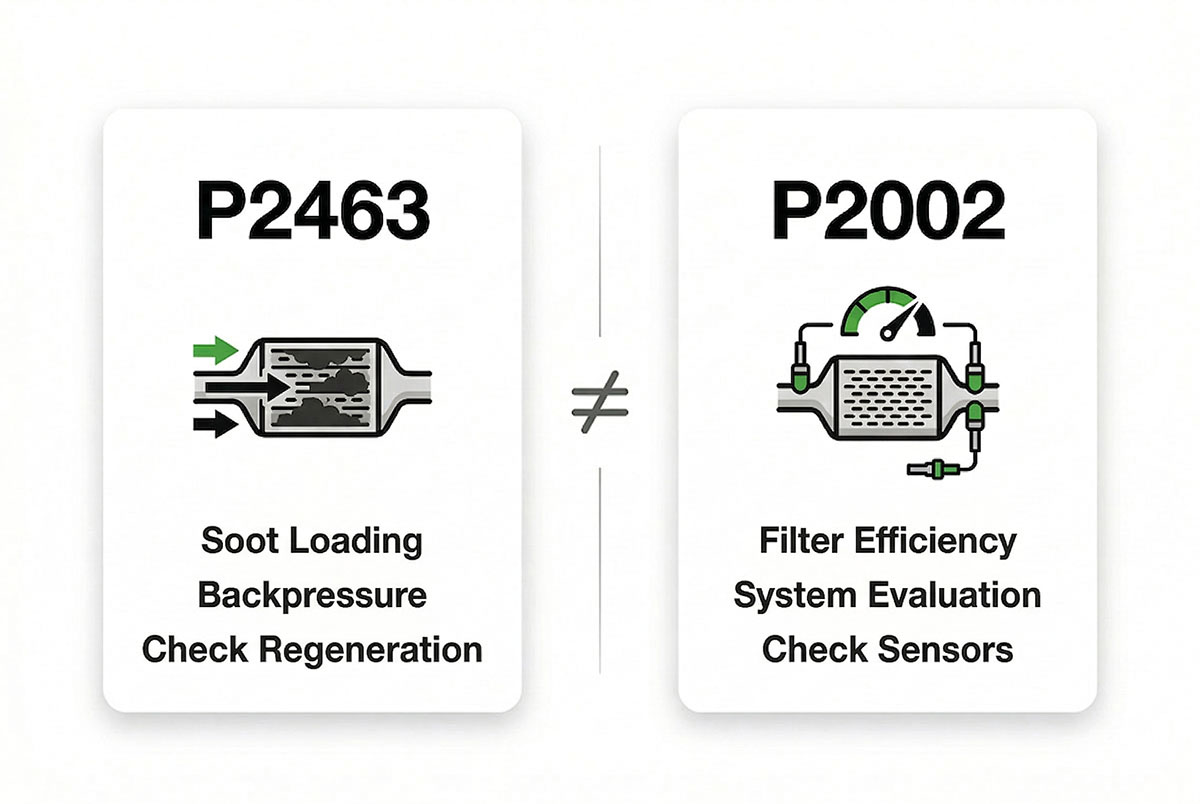
With P2463, the main question is whether the DPF was no longer able to reduce its soot load due to a short distance, interrupted regeneration or an accompanying fault. In the case of P2002, the question is more focused on why the system no longer recognizes the desired separation or monitoring effect. Although this can also be related to loading, it is also more often an indication of sensor technology, leaks or a filter that is already structurally damaged.
| Error code | Basic technical statement | Typical meaning in everyday life | Common contributory causes | Typical next test step |
|---|---|---|---|---|
| P2463 | DPF restriction due to soot loading | Filter closed, regenerations fail or values are implausible due to periphery | Short distance, differential pressure sensor, clogged pressure lines, temperature problems, air/exhaust fault | Check load, live data, regeneration history and sensors |
| P2002 | DPF efficiency below threshold | Filter effect too low or system evaluates the effect as implausible | Damaged DPF, sensor system, exhaust gas leak, incorrect pressure/temperature values, failed regeneration | Evaluate the effectiveness of the system, sensor values, leakages and filter status |
How urgent is this – can you continue with P2463 or P2002?
It may still be possible to continue driving in individual cases, but only carefully and not as a permanent solution. As soon as power loss, emergency running, frequent regenerations or heavy thermal loads are added, the risk of consequential damage increases significantly.
If the warning light, emergency running or recurring regeneration attempts are already in the foreground, this classification often helps first: DPF warning light on: Causes & immediate measures.
When it may still be possible to continue driving carefully
If the vehicle is still running normally, no emergency running is active and the fault occurs for the first time, a short-term, gentle drive to the workshop or for a targeted diagnosis may still be justifiable. This is especially true if there are no serious accompanying symptoms and the situation is checked promptly. Nevertheless, this is no substitute for a diagnosis, as even a faulty sensor system can lead to regeneration no longer being properly initiated or evaluated.
When it is better to stop loading the vehicle
It becomes critical if there is a significant loss of power, emergency running, recurring regeneration attempts, a strong odor after thermal stress or if the fault returns immediately after clearing. A clogged DPF increases the exhaust back pressure, and this can put a strain on other components. If this condition persists, the risk of consequential damage to adjacent components, including the turbocharger, increases.
Checklist: These warning signs speak against simply driving on
- Significant loss of performance
- Emergency run
- Frequent or aborted regeneration attempts
- Warning lights remain active
- Unusual odor or strong heat development
- Error returns immediately after deletion
Deleting errors is not a solution
Clearing the fault or simply continuing to drive does not eliminate the cause. If power loss, emergency running or recurring regenerations are added to this, a loading problem can quickly turn into major consequential damage.
Why do P2463 and P2002 often occur together?
Yes, both codes can occur together. However, this does not automatically mean that the DPF is definitely destroyed. Often the combination rather indicates that a loading problem is already affecting the filter effect or the system evaluation.
A typical pattern is: the filter becomes loaded with soot, regenerations are incomplete or not completed at all, the differential pressure increases and the control unit also recognizes that the expected effect of the system no longer seems plausible. In addition, modern DPF diagnostics are never based on just a single value. Control units generally evaluate several signals together, such as differential pressure, temperature and air mass. This is precisely why a common occurrence can also be favored by sensors or peripherals.
Generic code, manufacturer-specific diagnostic path
OBD fault codes are generic, but the specific diagnostic path differs depending on the manufacturer. The same code combination therefore does not automatically lead to the same repair for every vehicle.
What are the possible causes – DPF, sensor system or accompanying fault?
The most common misconception is to immediately suspect only the DPF itself. In fact, P2463 and P2002 can be caused by genuine loading problems as well as sensor faults, wiring problems and causes from the air, exhaust or combustion system.
Actual soot loading and failed regeneration
A classic trigger is excessive soot loading due to missing or repeatedly interrupted regeneration. Depending on the system, active regeneration requires specific high temperatures, while the loading status is monitored by the sensors. If these conditions do not occur, the restriction in the filter increases. Short distances, low loads and unfavorable operating profiles are therefore typical contributory causes.
Differential pressure sensor, particle sensor and lines
The differential pressure sensor is central to the DPF assessment. It compares the pressure before and after the filter via two lines and thus provides an important basis for assessing the filter load. If the sensor, plug, cable or pressure lines are damaged, melted or clogged, the control unit can draw false conclusions. A DPF problem then appears larger or different than it actually is.
Driving profile, short distances and regeneration interruptions
A DPF can only regenerate if certain thermal conditions are reached. If the coolant temperature remains too low or if the vehicle is only driven for short distances, regeneration is prevented or repeatedly interrupted. This is particularly important because it initially causes a loading problem, which can later lead to further error patterns.
We have explained in more detail how short distances, interrupted regenerations and increasing back pressure are connected here: Short distances & diesel particulate filter.
Other causes in the air, exhaust or combustion system
The cause may also lie outside the DPF. Leaks in the charge air system, for example, can lead to inefficient combustion and increased soot formation. In addition, problems with EGR, air mass, temperature detection or exhaust gas tightness can falsify the diagnosis or increase soot production. This is precisely why P2002 alone is not reliable proof of an irreparable filter.
What should be checked first?
The right approach is: check first, then decide. Anyone who immediately regenerates, cleans or replaces P2463 or P2002 without evaluating live data and accompanying faults risks unnecessary costs and recurring faults.
Fault memory, live data and regeneration history
At the beginning there is the fault memory, freeze frame data, current live values and the regeneration history. Among other things, the calculated load, differential pressure, temperatures before and after the DPF and information on whether regeneration was last successful are relevant. It is precisely these measured values that form the basis for the actual troubleshooting.
Check sensor values and pressure lines
The differential pressure sensor, plug connections, cables and pressure lines should then be checked. The lines in particular can cause problems due to heat, cracks or soot deposits. Incorrect pressure information can distort the entire DPF assessment.
Classify loading, temperature curve and accompanying errors
Only in the third step is it assessed whether the measured load is plausible, whether the temperature curves allow regeneration at all and whether accompanying faults from the air, boost pressure, EGR or exhaust system influence the result. This is where the question arises as to whether there is only a lack of functioning regeneration, whether professional cleaning is advisable or whether the filter could actually be damaged.
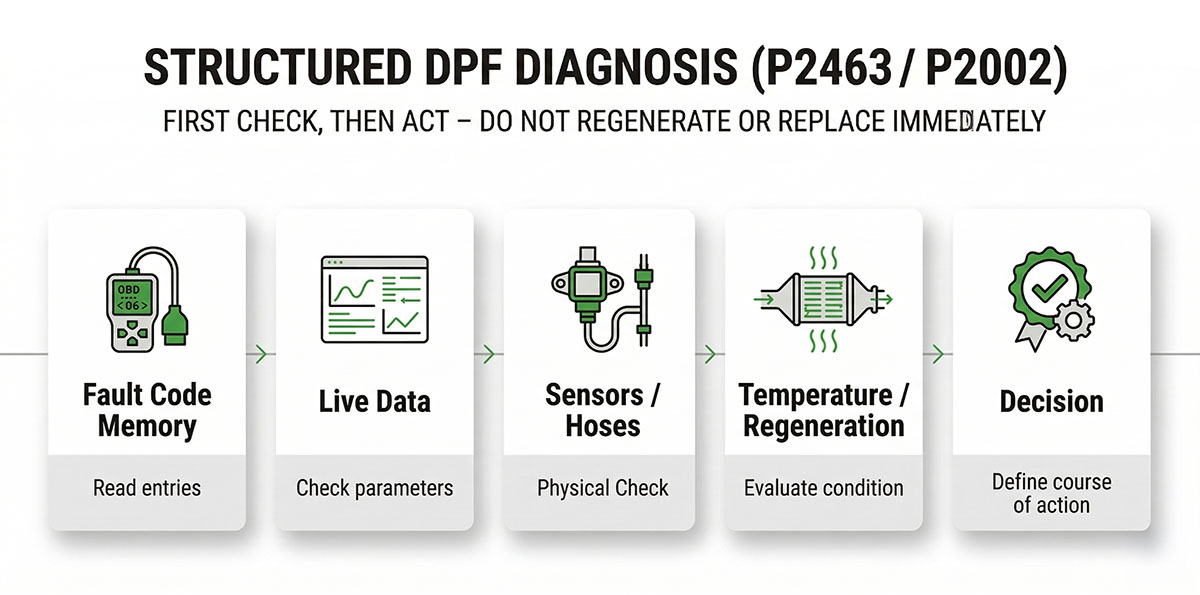
Checklist: Sensible diagnostic sequence for P2463 and P2002
- Check error memory and freeze frame
- Evaluate live data
- Check differential pressure sensor and lines
- Check temperature sensor and plausibility
- Evaluate regeneration history
- Classify driving profile
- Note accompanying faults in the air and exhaust system
- Only then decide on cleaning or replacement
Evaluate the overall picture first
Before discussing replacement, the load status, sensors, lines and regeneration history should be assessed together. This is where the decision is often made as to whether cleaning, repair or actually a new component makes sense.
Is regeneration enough – or is professional cleaning necessary?
Regeneration may be sufficient if the filter is still structurally intact, especially if it is loaded with soot. Professional cleaning is advisable if the loading is advanced, regenerations repeatedly fail or the filter is already so contaminated with ash and deposits that waiting any longer will hardly help.
When regeneration is still plausible
It is particularly plausible if the vehicle has been running predominantly under an unfavorable driving profile, there are no clear indications of a damaged filter and the sensors are basically working properly. Passive and active regeneration are a normal part of the system, depending on the temperature and driving conditions. However, it should also be checked why the previous regeneration was not sufficient.
If regeneration is still an option in principle, you will find the typical requirements, signs and limits in detail here: DPF regeneration: procedure & typical signs.
When cleaning makes more sense than waiting
If the differential pressure remains permanently high, regeneration no longer works or the ash load and restriction increase, professional DPF cleaning is usually more sensible than continuing to hope for “free driving”. This is because, unlike soot, ash is not simply removed during normal driving, but accumulates in the filter. This is precisely why cleaning can make much more economic sense than repeated, unsuccessful attempts at regeneration.
This separation is important for Advanpure: not every DPF needs to be replaced, but not every DPF is cleared by simply continuing to drive. The decisive factor is whether the filter is contaminated but still fundamentally intact.
When does P2002 tend to indicate a damaged DPF?
P2002 is more likely to indicate a damaged DPF if the system no longer achieves a sufficient filter effect in the long term despite plausible sensor technology, functioning regeneration and inconspicuous peripherals. Then cleaning alone is often no longer sufficient.
Indications of real filter effect below threshold
Recurring P2002 despite a clean diagnostic basis, conspicuous efficiency measurements, visible leaks or indications of thermal or mechanical damage to the filter body are suspicious. Even a filter that has already been damaged may no longer achieve the expected effect, even though the load has been reduced in the meantime.
When cleaning alone is probably no longer enough
If the filter structure is damaged, melted, cracked or the filter effect is permanently below threshold, you should not work with unrealistic expectations of cleaning. A sober assessment must then be made as to whether repairing the periphery is sufficient or whether the DPF needs to be replaced. It is crucial that this decision is not derived from the code alone, but from the complete diagnosis.
Cleaning, repair or replacement – what makes economic sense?
The measure that eliminates the actual cause and avoids follow-up costs always makes economic sense. This is why cleaning is often effective if the filter is contaminated but not destroyed; repair makes sense if sensors or peripherals are the main cause; replacement remains the step for genuine structural damage or filters that are no longer sufficiently effective.
Anyone who hastily responds to P2463 or P2002 with just a new DPF risks unnecessary costs. Conversely, simply deleting, freewheeling or repeatedly forcing regeneration is also not a clean strategy if the sensors, air system or filter condition speak against it. From an economic point of view, it is therefore not the quickest decision that counts, but the one with the best evidence. This is precisely where a structured diagnosis pays off.
Conclusion: Do not treat both error codes the same
Although P2463 and P2002 both relate to the DPF, they do not mean the same thing diagnostically. P2463 refers more to soot loading and restriction, while P2002 refers more to an efficiency or effectiveness problem in the system.
The right next step is therefore not blind actionism, but a clear sequence: classify the fault pattern, check live data, evaluate sensors and lines, understand the regeneration history and only then decide between regeneration, cleaning, repair or replacement. If you want to clarify the cause in a reliable manner, this structured diagnosis is the most economical way.
Frequently asked questions
P2463 usually indicates excessive soot loading or increased flow resistance in the DPF system. Common causes are failed regenerations, short distances or problems with sensors and pressure lines.
P2002 means that the filter effect of the diesel particulate filter is below the expected threshold or is assessed by the system as implausible. In addition to a damaged filter, sensor faults, leaks or incorrect measured values are also possible.
P2463 tends to indicate loading and restriction, P2002 tends to indicate an insufficient filter effect or a conspicuous system evaluation. Therefore, both codes should not be treated identically.
Careful driving may still be possible in individual cases in the short term if there is no emergency running and no severe accompanying symptoms. However, in the event of a loss of power, frequent regenerations or heavy thermal loads, the vehicle should be checked promptly and not subjected to any further loads.
This depends on the cause. Regeneration may be sufficient if the main cause is soot contamination and the filter is structurally intact. If the differential pressure remains high or the filter is already heavily loaded or damaged, professional cleaning or replacement may be more appropriate.
No. P2002 is not reliable proof of an irreparable filter. Only when the sensors, regeneration, peripherals and possible leaks have been properly checked can a reliable decision be made as to whether cleaning, repair or replacement is necessary.