
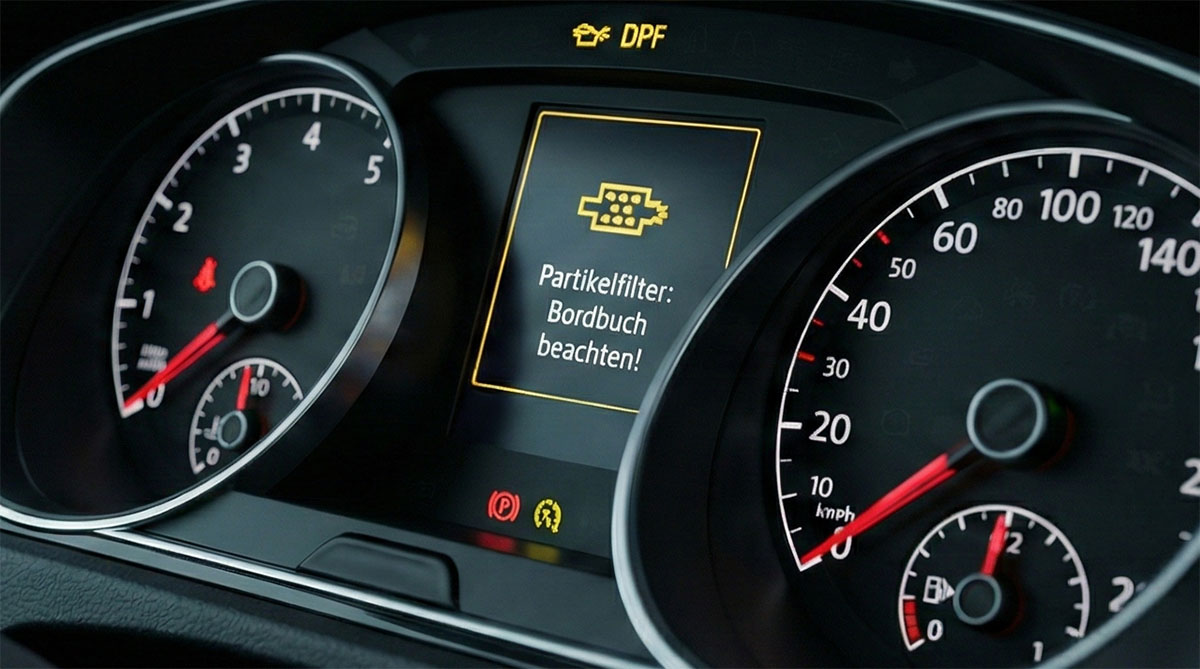
You drive off and suddenly the DPF warning light comes on. At first, you quickly think of an expensive repair – but there is often something much more mundane behind it: The diesel particulate filter is more heavily loaded with soot than usual and needs a clean regeneration.
One thing is particularly important: don’t ignore it, but don’t panic either. If you react correctly now, the problem can be solved quickly in many cases – and you can prevent a warning from becoming a real follow-up issue. In this article, I’ll show you the most common causes, sensible immediate measures and when a diagnosis or cleaning is the better option.
Content
- What does the DPF light mean?
- Immediate measures: What you can do right now
- The most common reasons why the DPF warning light comes on
- When you should stop “tasting”
- Workshop, regeneration, cleaning: What makes sense when?
- This will prevent the DPF light from constantly coming back on
- FAQ: DPF warning lamp – the most frequently asked questions
What does the DPF light mean?
The diesel particulate filter is located in the exhaust tract and filters soot particles from the exhaust gases. At some point, it becomes loaded with soot – the vehicle then tries to burn off the soot through regeneration (simplified: “burn it off”). If this does not work regularly, the system signals this via the warning light.
Important: DPF problems often do not occur “overnight”, but rather gradually – typically on short journeys, a lot of stop-and-go or when regeneration is often interrupted.
Immediate measures: What you can do right now
1) Check: Is only the DPF lamp lit – or more?
- Only DPF light, car drives normally: You can usually support regeneration in a targeted manner first (see below).
- Additional engine control light / emergency running / severe loss of power: Then there is a higher probability that a technical trigger is behind it (sensors, EGR, etc.). In this case: Have the fault memory read out instead of “driving to death”.
2) Check tank level
Sounds banal, but it is relevant in practice: Many vehicles do not reliably start a regeneration if the tank level is too low. VW explicitly states, for example, that you should first check whether the fuel warning is active when the DPF warning is displayed and refuel if necessary.
3) Regeneration drive (“DPF free driving”) – this is how it often works
If there are no other warning signs, it often helps to drive steadily so that the exhaust gas temperature is high enough:
- Warm up the engine (operating temperature)
- then drive constantly (country road/highway instead of city traffic)
- Do not slow down/stop all the time, no short distances in between
Manufacturer example VW: Volkswagen describes as a typical approach, among other things, at least 60 km/h, 1,800-2,500 rpm, at least 15 minutes until the light goes out (automatic possibly Sport).
Remember: Constant + warm + some load is better than short + cold + stop-and-go.

If the lamp does not go out after a sensible drive, this is an indication that either regeneration is not possible (e.g. due to secondary faults) or the filter is heavily loaded (soot/ash) and needs diagnosis or professional help.
Kein verknüpfter Beitrag ausgewählt.
The most common reasons why the DPF warning light comes on
Short distances and city traffic
The classic: The exhaust gas temperatures are not sufficient in everyday life for regeneration to run smoothly. ADAC cites city traffic/short journeys as a typical cause when the filter is clogged with soot.
Aborted regeneration
Some drivers hardly notice it: the car starts a regeneration, but you turn it off (e.g. after 8 minutes of driving). If this happens repeatedly, soot accumulates more quickly.
Technical triggers (often underestimated)
Regenerations may fail to occur or fail if, for example
- there is an error in the motor management,
- EGR problems exist,
- sensor values are implausible,
- or the tank is too empty.
Soot vs. ash – the crucial difference
Soot can be burnt off during regeneration. Ash (e.g. from oil additives/combustion residues) remains and accumulates over the running time. At some point, “freewheeling” alone is no longer enough – even if you do everything right. (With a very high ash load, even cleaning can reach its limits).
When you should stop “tasting”
At the latest then a diagnosis makes sense (instead of continuing to “freewheel”):
- The DPF light comes on again and again after a short time.
- The vehicle goes into emergency mode or does not accelerate well.
- Consumption increases significantly, while performance drops noticeably.
- Additional warning lights are illuminated (e.g. engine indicator light).
In these cases, there is often more than just “too much soot due to short trips” – the fault memory should then be read out and the cause specifically checked.
Workshop, regeneration, cleaning: What makes sense when?
1) Workshop regeneration (forced regeneration):
If the DPF is heavily loaded with soot, the workshop can often initiate a manual/forced regeneration – provided the general conditions are right (sensors, fault situation, etc.).
2) Professional DPF cleaning:
If the filter is not only sooty but also ash-laden, cleaning is often an interesting option – especially before you consider replacing it. A professional procedure typically consists of several steps (cleaning + controlled processes + measurement/record).
This is how professional DPF cleaning typically works:
First, soot and ash residues are removed using a multi-stage process (e.g. wet and/or thermal, depending on the provider). The filter is then dried and metrologically tested – for example by weight, flow rate or back pressure. A measurement report is a good sign because you can see in black and white what has been achieved.
How to recognize a reputable provider:
Transparent fixed prices, documented measured values, comprehensible process and clear statements on the warranty (including the conditions, e.g. correct installation and rectified engine cause).
3) Exchange:
If the filter core is damaged, thermally damaged or extremely “clogged”, replacement may be the better choice. You can also name such exceptions yourself (e.g. damaged filter core, thermal damage, rarely: excessive ash deposits).
This will prevent the DPF light from constantly coming back on
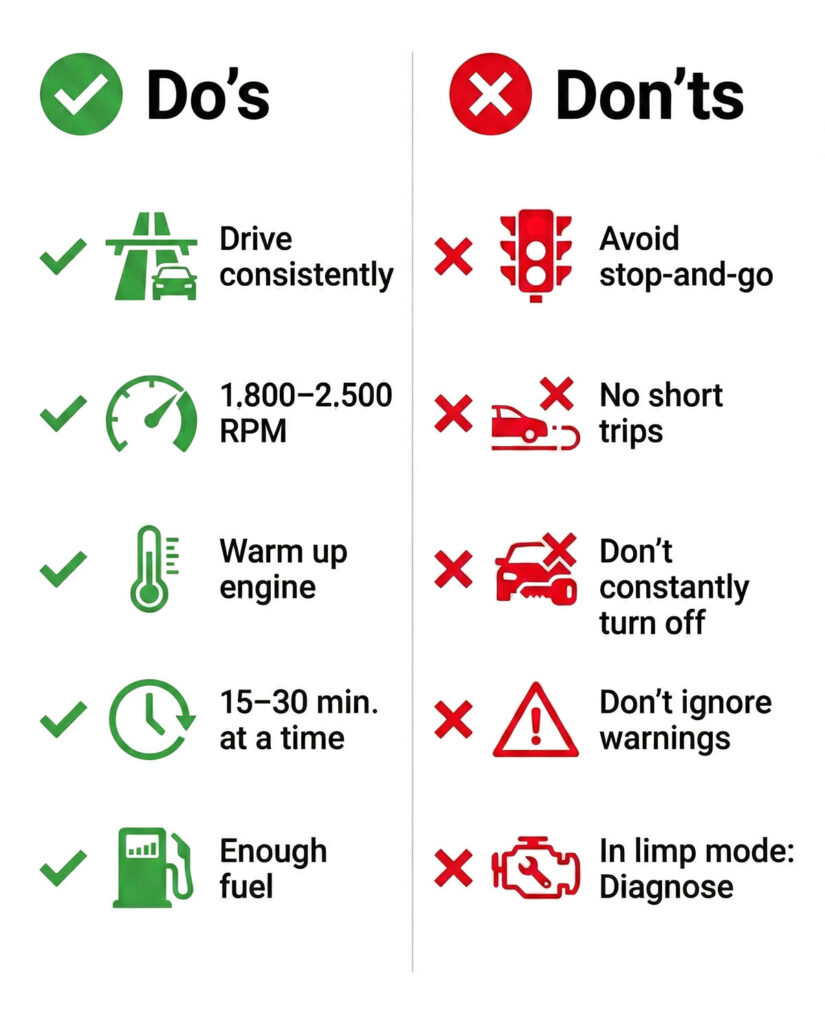
- Give the diesel a regular chance to regenerate: longer, steady journeys
- Avoid “continuous short trips” (or consciously plan a longer trip once a week)
- If the light comes on frequently: Have the cause checked (EGR, sensors, engine management)
- After DPF work: ensure that installation/environmental faults are clean (otherwise the problem will quickly return)
FAQ: DPF warning lamp – the most frequently asked questions
It usually signals that too much soot has accumulated in the diesel particulate filter and regeneration is necessary. This is often a driving profile issue (lots of short trips/city traffic), but can also indicate a technical problem if the light recurs or other warnings are added.
If the car is running normally and no other warning lights are active, you can usually still drive – but not for weeks. It makes sense to allow a regeneration drive as soon as possible. If the vehicle goes into emergency mode, loses a lot of power or the check engine light is also on: it is better to have a diagnosis than to continue driving.
Bring the engine up to operating temperature and then drive evenly (country road/highway), without constant braking or stop-and-go. It often helps to drive constantly for 15-30 minutes and keep the engine speed moderate. The decisive factor is: constant + warm + without interruption.
Then there is often more to it than “just a short distance”. Frequent reasons: Regeneration has been interrupted, there is a secondary fault (e.g. sensors/AGR), or the filter is more heavily loaded – sometimes with ash that cannot be “burned free”. In this case, the only thing that usually helps is to read out the fault memory and carry out a specific check. If there is already a specific DPF error code behind the warning light, the next level of diagnosis is worthwhile: What P2463 and P2002 actually mean and how to separate the two cleanly.
Very common: short journeys, lots of city traffic, interrupted regenerations. However, if the light comes back regularly, there may also be technical causes – for example, problems in the EGR system, sensor values, injectors, boost pressure/oil input or other engine management issues. Then you should stop guessing and measure/diagnose instead.
They can have a supporting effect in individual cases, but are no substitute for a proper diagnosis and do not solve an ash problem. If a filter is regularly conspicuous or the vehicle goes into emergency mode, this is usually not an “additive problem”, but a case for a root cause analysis and, if necessary, professional cleaning.
Extinguishing the lamp does not eliminate the cause. If the filter is actually loaded, the warning will quickly return – in the worst case with consequential damage. It makes more sense to allow regeneration, check the error and only reset when the cause and actual values match.